Online Conference 5-11 July 2021
February 2–7, 2027
Vienna, Austria
Professional Development Workshop
Tuesday 2 February
Full day workshop
Code: PDW 1
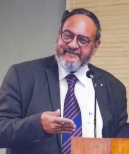
Presenter: Ajeet Mathur
Ajeet Mathur
Larry A. Hirschhorn
Ajeet Mathur is an Affiliate Life Member of the Indian Psycho-analytic Society and Yoga Shikshak and Karma Sannyasin of the Bihar School of Yoga. His publications include 33 books and over 160 papers in scientific journals and anthologies. He directs Group Relations Conferences in Europe and India. He was Director and CEO of the Institute of Applied Manpower Research. He has served on the Board of Directors with Corporates in India and Europe, with the School of Inter-disciplinary Studies, IGNOU and ISPSO. He is Professor Emeritus, New Delhi Institute of Management and has been Professor of IIMs Ahmedabad and Calcutta, and the EU-Tempus Professor of European Integration and Internationalization. He received his Ph.D. Degree from Indian Institute of Science Bangalore and has held visiting academic appointments at K.U. Leuven, University of California at Berkeley, Aalto University and Tampere University, among others. He has received several national and international honours and awards.
“East is East and the West is West and never the twain shall meet”
Nobel Laureate Rudyard Kipling
Omnipotence and incompleteness characterise the trine of distress, despair and depressive anxieties that pose formidable challenges in consulting to organizations. These challenges concern, inter alia, yet another trine: return of the repressed, narcissistic injuries, and residual trauma that can continue to breed organizational toxicity and haunt organizations for a long time. When structures depart from pyramidal shapes towards matrix forms, and strategies require wicked problems to be addressed, complexity in process involves intentions and desires that are not easily understood.
In this context, consultants and coaches who work with system psychodynamics require cutting edge capabilities. These have to be commensurate with authority of skill and responsibility arising from expectations in contractual commitments with clients and client systems. Exploring and learning from the range and diversity of practices at the frontiers of psychoanalytic studies of organizing point to the need to understand practices and concepts arising from insightful experiences reported from around the world-the East (China, India, Japan, Central and Eastern Europe) and West (UK and Continental Europe), Nordic Europe and Africa.
Do you have a sense of incompleteness about your diagnostic skills despite your undoubtedly enormous learning? Are you interested in exploring Bose’s theory of ‘opposite wishes’, Bharatmuni’s taxonomy of ‘rasas’ in experiencing emotions, Charak’s therapeutic doctrine of ‘spiritual healing, and the unconscious’, Tao and Zen Buddhism. Aurobindo’s concept of consciousness, and Abhinavagupta’s theories connecting ‘aesthetics with emotional experiences’ beyond Freudian concepts around ‘libido’, Jungian notions of ‘psyche’, Moreno’s ‘tele’ and the Lacanian idea of ‘jouissance’ in your consulting or coaching practice? Here is an opportunity to broaden, deepen and sharpen diagnostic and therapeutic skills where you can co-creatively expand perspectives and horizons at the cutting edge of practice. This one-day professional development workshop (PDW) is designed to
a. introduce participants to the core of what is common to Western, Eastern and Nordic theories and practices for understanding mysterious life forces in our nature at the frontiers of psychoanalytic, socio-analytic and system psychodynamic process work.
b. invite reflections on work lives in and with groups, teams and organizations in choosing between modes of doing centred around being and becoming or having and using.
c. familiarise participants with methods for researching unconscious processes in a plurality of traditions-convergent and divergent- together with their limitations and challenges.
d. introduce the theory and practice of how emotional experiences evoke aesthetic crystallisations of psychological states and discuss horizons of experiential learning 3 from the perspectives of Bionian and post-Bionian ‘basic assumptions’ in group relations.
e. invite participants to understand basics of ‘prana vidya’ for design of accelerated experiential learning in several countries, including Australia, Bulgaria, Finland, France, and India since the 1960s.
Those who participate in this PDW will be provided with an additional reading list to continue learning beyond the PDW.


 Translate