

 Translate
Rose Redding Mersky
| Susan: | I have been asked to write an obituary for a departed friend, and I really don’t know where to start. Every life is complex, rich, with depth and variety and this one is no exception. I only have one slice of such an expanse. I feel anxious about this task. Can I do it justice? | |
| Rose: | You can do it. But as always, do it in your own way. You don’t have to follow a set formula. Write with your heart as well as your mind. You know, that is what I have always tried to do. | |
|
Susan:
|
Yes, and I appreciate that, your heart is big and welcoming. So many people speak of the warmth and support that you give, as well as your knowledge and wisdom. But so many have been with the per-son I write about and have experienced her in so many different ways. I can’t speak for each of them. | |
| Rose: | And you don’t have to. Remember when we worked together, thinking about professional development in ISPSO. How, as two women past presidents we might bring forward young people on their professional journeys. Remember how we followed our wishes for the future, hoping we were wishing for others, consulting, yes, but with our own determinations? Speak for yourself and let others resonate. | |
| Susan: | Rose, your support and words strengthen me. Thank you! … But, so sadly my dear Rose, how can I say this, how to say farewell? The obituary is for you. | |
| Rose: | I know it is. It is all so desperately hard. Life is too short, and its joys become lost too quickly. I didn’t want to go. But there it is. I will reunite with Burkard and find some peace. You will find your own way to grieve. I have had my share, my losses, my deep losses. And yet I am here while you write. So, Susan, get on with it. |
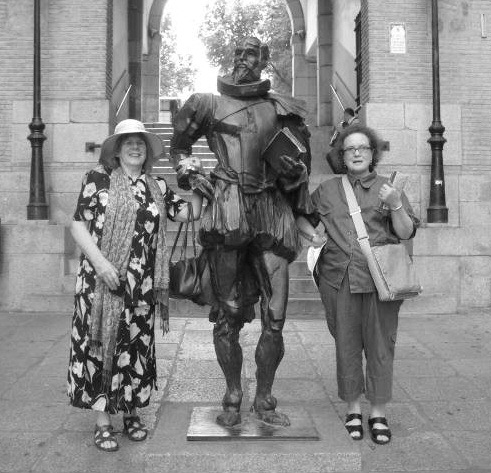
Susan Long (on the left), with Rose Redding Mersky (on the right).
Rose Redding Mersky
A distinguished member of the International Society for the Psychoanalytic Study of Organizations, Rose served as its first female president (1997–1999) and its first Director of Professional Development (2000–2006). She was a faculty member of the Program in Organizational Dynamics and Consulting at the William Alanson White Institute in New York (1993–1998). Co-director of the Program of Organizational Dynamics sponsored by inscape-international in Cologne, Germany (2001–2010), and an Honorary International Trustee of the former Gordon Lawrence Foundation for the Promotion of Social Dreaming (2016–2019). She was an honorary professor at the National Research University: Higher School of Economics in Moscow, teaching master classes (https://ispso.org/Distinguished-Members-Post/Rose-Redding-Mersky).
Two nights before hearing that my dear friend, Rose Mersky, had died, I woke, not in terror, although that lurked somewhere, but in sorrow. I had a feeling of my own mortality and wondered how I would die. What would the ending be and what would be the experience? I am not continuously morbid—even as I grow older, but sometimes the thoughts come, unbidden, and this was one time. I told my husband and he, as he often lovingly and teasingly does, turned to joking. But, especially now, I feel uneasy about such premonitions from the unconscious. Excited and uneasy.
I first met Rose in 1991. We met when I went to New York with Gordon Lawrence and Alastair Bain to run a social dreaming event at the William Alanson White Institute. Rose was a workshop member, keen and engaged. It was a memorable event with many startling dreams and—on the subject of premonitions—there were numerous dreams of white vans. The day of the end of the workshop, on leaving the Institute we saw a white van parked in the street. Amazingly on its side (it was a builder’s van) were written the words “You dream it: We build it”. We laughed. The associative unconscious?
I later met Rose at The International Society for the Psychoanalytic Study of Organizations (ISPSO) and was delighted to see her again. I supported her hope to become the first woman president of ISPSO—a hope that was fulfilled. She was dedicated to the Society and continued to serve it so well, right up to her final days. She encouraged me when I nominated for the presidency a few years later. There were few women members in the early days. Later, we worked together when she led the process of developing the workshop program at ISPSO annual meetings. And then, delight upon delight, we formed with some other women members a small group that was to meet year after year at annual symposia (when we could) and still keeps in touch to greater or lesser degrees. At the symposium in Paris, we shared an apartment and named ourselves Les Chiquitas—the chicks. The group was Rose Mersky, Marlene Spero, Marisa Guerin, Anne Kemp, Paula Singer, and me, Susan Long. We, the surviving five, met recently online to remember Rose. I suspect there are others who have shared memories, and I know an online site has been created for memories to be posted.
I saw and lunched and went to papers with Rose at so many symposia and annual meetings. We also sometimes took holidays together following these meetings. I have so many memories of happy times and great conversations: shopping in New York, sightseeing in Rome, lunching in Paris. Given the state of the world now, these moments were so blessed, we so privileged. Halcyon days.
But it was not all holidays. I have had the pleasure of working quite intensely with Rose on many occasions, in Germany, Russia, here in Australia, and at ISPSO meetings across the decades of the late 1990s to the 2020s, each time learning something new from the co-creation of work. Her generosity in learning was notable. For instance, a Group Relations conference that I directed in Australia—where I had advertised a prominent person in the field as my associate director leading an advanced group—was suddenly bereft as that person withdrew within the week prior to the conference. I rang Rose in Germany and asked if she would take the role, of course understanding the very late request and expecting that she could not. Wonderfully, she answered the next day in the affirmative, moving other engagements in order to come. After that she was named in my household as “Rose to the rescue”. The conference benefitted greatly from her dedicated presence and her professionalism, leadership, and intuition in role.
Rose was an accomplished organisational consultant and executive coach, in the USA and later in Germany. I can only touch here on her accomplishments and won’t cite all her papers. However, an early paper where she writes about her consulting experiences gripped me for its clarity and courage and I gave it to many of my students. She wrote about what appeared as a mistake—courageous to admit in print—and that led to a deal of insights and learning. The paper was: “‘Falling from grace’—when consultants go out of role: Enactment in the service of organizational consultancy”. This paper was the winner of the William Alanson White Institute for Psychoanalysis and Psychotherapy annual prize for best paper on applied psychoanalysis in 1998. Of course, as a journal editor, I wanted to publish it (Mersky, 2001). Her later article on the experience of being a PhD student (Mersky, 2018) is also an invaluable aid for our PhD candidates at the National Institute for Organisation Dynamics Australia (NIODA).
Rose came to formal academic research late in life and did it with aplomb, taking up a PhD with the University of West England. She had been long interested in social dreaming and had often worked with her late husband, Burkard Sievers, with his innovation of the social photo-matrix. A well-experienced group and organisational consultant, she came to develop and use what she named as “social dream-drawing” a method that used a dream matrix (following Gordon Lawrence’s method) and then encouraged participants to draw their dreams and from there, in free association with others, to access the associative unconscious. This method was developed over many years of work and study (see Mersky, 2008, 2023). Rose successfully conducted workshops with this and other socioanalytic methods in Europe and the USA. Many people learned from her through this method and students have taken it up to use in their own research and consultancies to organisations. In a short obituary, ISPSO has said: “The Social Dream Drawing Workshop: A Handbook for Professionals is widely regarded as an essential guide for those working with groups and individuals through change” (ISPSO Newsletter, April, 2025).
To move again to the more personal, I can agree with the many others who wrote about Rose when they heard of her death, that she was warm, engaging, helpful, thoughtful, and generous. The ISPSO listserv was filled with sadness as well as memories of joy. She exuded energy even in the face of illness. Those of us at Sophia in 2024 were witness to her zest for life. We had many good laughs and dances together.
Rose showed strength as well as vulnerability in her adversities. She gave what must have been her last online seminar to our PhD candidates in February, 2025, a time when she must have been quite ill but did not show it. (I am uncertain if she gave any seminars elsewhere after this.) The seminar was received extremely well. Moreover, she had two beloved husbands die before her—sharp grief to live through. Her care of Burkard during his decline was done with empathy and deep love. And she could be fierce and strong in her movement through life and work. It amazed her friends that in middle age she could move to Germany, enter a new family, learn a new language, and build a new career. Ullrich Beaumer, a colleague from Germany, allows me to say here something of what he told me:
The news of Rose’s death was extremely sad news for us, especially because an important part of the history of the founding and development of our institute “Inscape” is connected with her. We got to know each other around the turn of the millennium. At the beginning her transition from the USA to Germany, the new partnership with Burkard and our support from them were very much in the foreground.
In 2002, the first major project we designed with her was a training course on “management and consulting for organizations (organizations in depth)”, which she ran together with Burkard until 2008 for several times and which, when I look at it again today, was in some ways far ahead of its time and could be offered and successful in the same way today.
Rose was also instrumental in setting up the new Inscape Institute. She supported us in organizing the first ISPSO symposium in Germany in 2004 in Coesfeld which I was hosting in my role as symposium chair.
Rose was involved in the establishment of various workshops at Inscape on “organizational watching”, “setting up our own consulting institutes” and other activities. It was also during this time that we both worked together on our doctorates; we were constant discussion partners there as doctoral students who only realized this project at an advanced age, she in England, I in Frankfurt at the Sigmund Freud Institute. There were always personal and content-related connections, Rose Mersky shared my fondness for spaces and the material environment in a very nice article (“Lost in transition”). Rose was an extremely inspiring, encouraging and optimistic friend and colleague, despite all the challenges she too had to overcome. We are very sad that she has now passed away and will keep her close to our hearts.
(Personal email from Ullrich to me, May 2025)
Her deep commitment to ISPSO will always be remembered because it lies within the heart of the organisation, in the annual meeting events that she helped design, in the many members that she supported, and in the scholarship that she contributed to and nurtured in others. At NIODA and at Group Relations Australia (GRA) we are indebted to her generosity in sharing her work and in her support for us.
I end this with a poem I wrote for her some years ago.
Rose Red
I saw her in a dress of warmest blue
Stolen from the summer sky where heat shimmers
Through the sun’s bright rays.
The delicate flowers of late winter and spring have gone
Daffodils fade; tulips shrink back
Gentle violets have hidden
But her colour has not waned; her brightness not diminished.
She rises from the greens and browns
Rose red in blue dress—summer queen
Ready to face the autumn, even the winter
With her strength and beauty.
To Rose with Love on her 65th
From Susan
Goodbye Rose.
- by Susan Long
References
Mersky, R. R. (2001). “Falling from grace”—when consultants go out of role: Enactment in the service of organizational consultancy. Socio-Analysis, 3: 37–53.
Mersky, R. R. (2008). Social dream drawing: A method in the making. Socioanalysis, 10: 35–50.
Mersky, R. R. (2018). The challenges of being a mature doctoral student: The supportive role of vertical and lateral third spaces. In: A. M. Cummins & N. Williams (Eds.), Further Researching Beneath the Surface, Vol. 2 (pp. 143–159). London: Routledge.
Mersky, R. R. (2023). Social Dream Drawing Workshop: A Handbook for Professionals. London: Routledge.
This text was first published in Organisational and Social Dynamics, Vol 25, Number 2. OSD and Susan Long, both have agreed to publish this on the ISPSO website.